
By Nick Shepley · Updated 10 November 2026
The short answer: when your players go off script, don’t drag them back. Follow them, keep the villains and scenes you prepared, and move them to wherever the players have gone. Let the world react to what the players do, and your story will find its way back in.
Every game-master has had the moment. You’ve prepared the adventure. You know where the guards stand, what’s in the vault and when the double-cross lands. Then your players look at all of it and go somewhere else entirely.
Here’s the time it happened to me. It was entirely my fault, and it was one of the best games I’ve run.
In this article
The heist that never happened
I was running a cyberpunk game. The setup was simple. A shadowy middleman hires the crew to break into a corporate data fortress and bring back some intel. What the players didn’t know was that the middleman was setting them up for a betrayal.
Players in a cyberpunk game are cautious and cunning, and these ones had a whole city to play with. They meant to use it. So instead of doing recon on the target, they went after the man who’d hired them. They crossed the city to find out everyone he knew and everything he’d done. They went through arcologies, underworld gambling dens and fighting rings, building up as much intelligence as they could.
Without asking my permission, they had started a completely different adventure. And I sat there thinking: the whole game I’d planned has just disappeared. But something better has turned up in its place.
Is it bad when players go off script?
No. It’s usually the best sign you’ll get that your players care about the game.
A heist done well is exciting. But cyberpunk can easily become heist after heist after heist, and that gets boring. My players had turned the game into something else: an intelligence game, a slow hunt through a city for the truth about one man. They chose it, so they cared about it.
That, to me, is great roleplaying. It’s what we sit down at the table hoping for.
What “going off script” means: your players ignore the adventure you prepared and follow a direction of their own. It isn’t a failure of prep. Usually it’s the table telling you what it finds interesting.
Why does it feel so hard for the GM?
When players take the story somewhere you didn’t plan, it’s a challenge to the GM’s ego. You’re supposed to be leading the game, and suddenly the players are leading it, coming up with ideas faster than you can react.
The trick is to change what you think your job is. For that stretch of the game, you’re not the author. You’re the facilitator of a story the players are forming. You still run the world. You just let them steer for a while.
How do you get your story back?
None of my preparation was wasted. It just turned up somewhere else.
As the players dug, they found out the man who’d hired them was far more complex, and far more dangerous, than they’d bargained for. Meanwhile, the corporate security team I’d built for them to fight during the heist had their own reasons to be watching him. They’d been suspicious of him for some time. And they noticed that someone else was on his tail.
That was the moment the pendulum swung back to me. The security team captured the player characters and interrogated them to find out what they knew about this man, who was a threat to the corporation too. In the end, the crew who were supposed to rob the company formed an alliance with its security team to take on the real villain.
The game I’d intended went up in smoke. It didn’t matter. The villain I’d planned, and the opposition I’d prepared, were still at the heart of the story. They just met the players in a different order and on the players’ terms.
The Pendulum: leadership at the table swings back and forth. The players lead for a while and you facilitate; then the world pushes back and the focus swings to you. Your job while they lead is to keep the world moving, so the swing back comes naturally.
What should you do when players go off script?
Follow them, and bring your story to where they are. Here’s what to take into your next session.
- Don’t be precious about the plot. Holding on too tightly, and forcing players down the avenue you prepared, kills the thing that makes tabletop games special.
- Ask whether the new direction is better than yours. Often it is. Mine was.
- Keep your prepared pieces. Move where they appear. My security team never met the players in the vault. They met them in the street, for a better reason.
- Let the world notice what the players do. Characters with their own agendas will react to the players poking around. That’s how your story finds its way back in.
- Wait for the pendulum. The players lead for a while. Then the world pushes back, and the focus swings to you again.
The magic of the table
Maybe the moral of the story is this: the table creates what it creates. We nudge it and we shape it a little, but it does what it does. Perhaps the best thing a GM can be is a witness to it, taking part in a story everyone at the table is making together.
So the next time your players walk straight past the adventure you prepared, don’t panic. Something better may be about to happen.
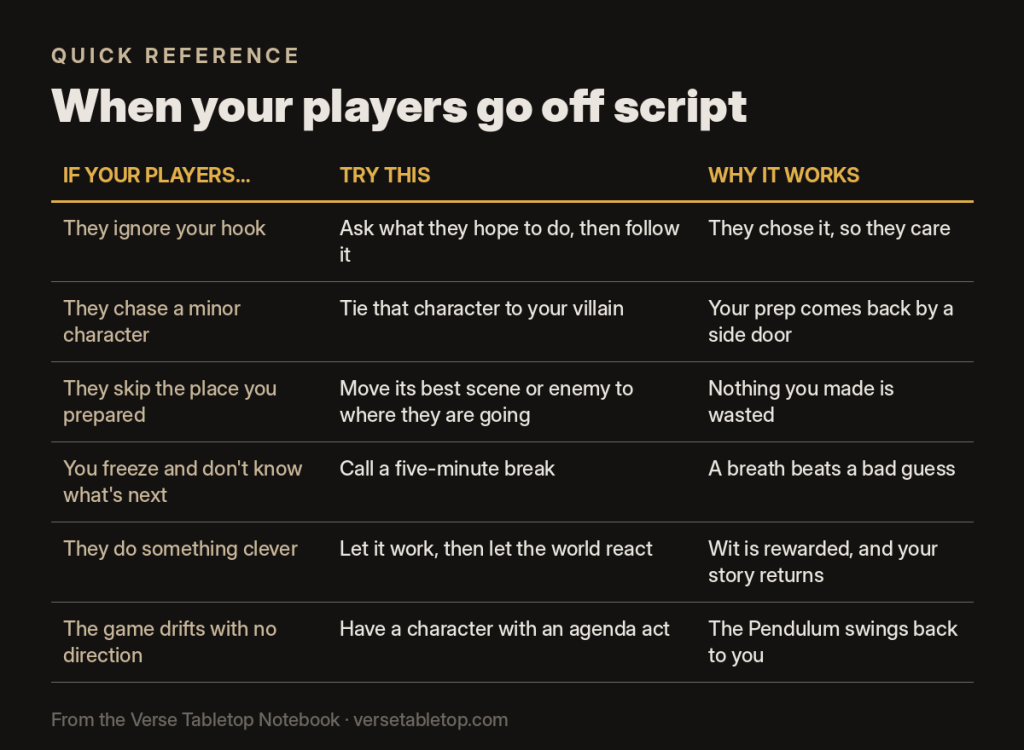
Quick reference: when your players go off script
| If your players… | Try this | Why it works |
|---|---|---|
| Ignore your hook | Ask what they hope to do, then follow it | They chose it, so they care |
| Chase a minor character | Tie that character to your villain | Your prep comes back by a side door |
| Skip the place you prepared | Move its best scene or enemy to where they are going | Nothing you made is wasted |
| Leave you frozen, not knowing what’s next | Call a five-minute break | A breath beats a bad guess |
| Do something clever you didn’t expect | Let it work, then let the world react | Wit is rewarded, and your story returns |
| Drift with no direction | Have a character with an agenda act | The Pendulum swings back to you |
Free printable cheat sheet
The table, the five moves and the Pendulum on one A4 page. Print it and keep it behind your screen for the next time a session swerves.
Questions GMs ask
What does it mean when players go off script?
It means the players have stopped following the adventure you prepared. They might ignore the hook, chase a minor character, or come up with a plan you never imagined. It happens at every table and in every system, and it’s rarely a sign that anything has gone wrong.
Is it railroading to bring players back to the plot?
It is if you force it: blocking their choices, making their plans fail for no reason, or having the world ignore what they do. Bringing your material to them is different. Moving your villain or your set piece into the path the players chose respects their choice and keeps your story alive.
How much should I prep if my players keep going off script?
Prep situations, not plots: who wants what, what they’ll do if nobody stops them, and a few strong scenes you can drop in anywhere. Justin Alexander’s essay Don’t Prep Plots at The Alexandrian is the classic piece on this.
What should I do if I freeze when players go off script?
Call a five-minute break. Nobody minds. Use it to ask yourself two questions: who in the world would notice what the players just did, and what would they do about it? Keep a list of spare names and places to hand so you never stall on the small things. The GM’s Emergency Kit, which is free, has quick fixes for exactly these moments.
How do I use the prep my players skipped?
Keep anything that isn’t tied to one location: the villain, the fight, the reveal, the clue. Move it to where the players are heading. Phil Vecchione makes the same point at Gnome Stew in When Play Does Not Go to Prep: small deviations can be absorbed by moving elements somewhere else.
Should I tell my players they’ve gone off script?
Usually not. If they’re enjoying it, there’s nothing to fix. If the table seems lost, or one player is pulling everyone somewhere the others don’t want to go, a quick out-of-character chat is fine. Ask what they’re hoping for, and build from the answer.
Does this work in any roleplaying game?
Yes. My story comes from a cyberpunk game, but the same moves work in fantasy, horror, superheroes or anything else, because they’re about how you run the table, not about any one rulebook. It’s the same idea behind Table Ready, my own line of system-neutral tools for game-masters (so I’m biased, of course).
If you want something in your back pocket for the next time a session swerves, the GM’s Emergency Kit is free: ten pages of quick fixes, for any game. New here? Start here for everything else that’s free from Verse Tabletop.

